Galvanised Pipes in Your Older Melbourne Home? When to Replace Rather Than Patch
Galvanised steel pipe was standard in Australian homes for decades, and a great many Melbourne houses still run on it. It fails from the inside, where nobody can see it, and by the time you notice the symptoms the pipe has usually been narrowing for years.
The question most people ask is whether they can just fix the bit that is leaking. Usually they can, and often they should not, because patching galvanised pipe with copper can accelerate the corrosion in everything it connects to. This covers how to tell what you have, how to read the symptoms, and where the line sits between a repair and a re-pipe.
In short
- If your plumbing has not been upgraded in about 40 years, galvanised pipe is likely. It is grey and roughly 25 mm across.
- It corrodes internally and narrows, so flow at the tap drops while pressure at the meter still reads normal.
- Joining copper straight onto galvanised steel with no dielectric break speeds up the corrosion, which is why partial repairs often fail.
- Fill a white container first thing in the morning. Rust particles or discolouration two or three mornings running means get it inspected.
- Do You Actually Have Galvanised Pipe?
- How Galvanised Pipe Fails
- The Symptoms, in the Order They Appear
- Why Patching Can Make It Worse
- When to Replace Rather Than Patch
- What a Replacement Involves
- What Drives the Cost
- Talk to a Licensed Plumber in Melbourne
- Related Plumbing Services
- Frequently Asked Questions
Do You Actually Have Galvanised Pipe?
Three checks, and you can do all of them yourself in about five minutes.
The Age Test
The useful rule of thumb from the water industry is that if the plumbing has not been upgraded in roughly the last 40 years, galvanised pipe is likely. In Melbourne that puts most unrenovated housing stock built before the 1980s in the frame, which is a very large number of houses across the inner and middle suburbs.
Renovations complicate this. A bathroom redone in 2005 may have replaced the pipework in that room and left the rest of the house on the original galvanised. That mixed situation turns out to matter a great deal, and it is covered further down.
What It Looks Like
Galvanised pipe is grey rather than the orange-brown of copper, and the common domestic size is around 25 mm across. It is threaded rather than soldered, so the fittings are chunky screwed elbows and sockets rather than neat soldered joints.
Look where pipework is visible: under the house, in the laundry, at the hot water system, or where a pipe runs up an external wall to a tap. If you see grey threaded steel anywhere, assume the rest of the original run matches it.
The White Container Test
This is the test the water authorities recommend, and it costs nothing.
First thing in the morning, before anyone showers and before any toilet is flushed, fill a small white container from a tap. You want the water that has been sitting in the pipes overnight, because that is the water that shows what the inside of the pipe is doing. If it is discoloured or carries rust particles, repeat the test the next morning, and once more after that.
If the result holds across two or three mornings, that is your answer and it is worth getting a licensed plumber to inspect. A single bad morning after mains work in the street is a different thing and usually clears on its own.
How Galvanised Pipe Fails
Corrosion From the Inside
The galvanising is a zinc coating protecting steel. Water gradually depletes that coating, and once the steel beneath is exposed it rusts. The rust does not simply thin the wall, it builds up as a rough scale on the inside of the pipe, so the bore gets narrower year after year while the outside of the pipe looks perfectly fine.
Reassuringly, the water authorities describe the oxidised iron this produces as generally not harmful to health. It is an aesthetic and performance problem rather than a safety one, which is worth knowing if the discoloured water has been worrying you. What it does damage is your flow, your appliances and eventually the pipe itself.
Pressure Is Fine, Flow Is Not
This distinction explains almost every frustrating experience people have with galvanised pipe, so it is worth being precise about.
Pressure is the force in the pipe. Flow is how much water actually arrives at the outlet. A narrowed pipe barely changes the pressure a gauge reads at the meter, but it strangles the volume that can get through. So a plumber can test your pressure, find it perfectly normal, and you still cannot run a shower while the washing machine fills.
This is why new tapware, a new shower head or a pressure pump so often fail to fix the problem. None of them widen the pipe. If you have been chasing this, our guide to low water pressure in your home covers the full list of causes and how each one gets ruled out.
The Symptoms, in the Order They Appear
Galvanised pipe gives plenty of warning. The trouble is that each stage is easy to explain away on its own.
Swipe the table to see more →
| Stage | What you notice | What it means |
|---|---|---|
| Early | Discoloured water on the first draw of the morning, clearing after a minute | Scale forming inside the pipe. Nothing urgent, but the clock has started. |
| Early | A metallic taste, and rust-coloured staining in basins, the toilet pan or the washing machine | Iron carrying through to the outlets. Appliances and laundry start to suffer first. |
| Middle | Two outlets cannot run at once, and flow is worse at the furthest or highest tap | The bore has narrowed enough to limit volume. Pressure tests will still look fine. |
| Middle | Water filters and shower roses blocking repeatedly | Scale breaking loose and travelling. A sign the internal surface is deteriorating. |
| Late | Weeping or pinhole leaks, often at a threaded joint | The wall has thinned through. More will follow in the same run. |
| Late | A second and third leak within months of the first | The system is at end of life. Repairs are now buying weeks, not years. |
Running an affected tap for a minute or two in the morning does clear the discoloured water, and there is nothing wrong with doing that. Just be clear that it manages the symptom and does nothing at all to the cause.
Why Patching Can Make It Worse
The Dissimilar Metals Problem
Here is the part that catches people out, and it is the main reason this article exists.
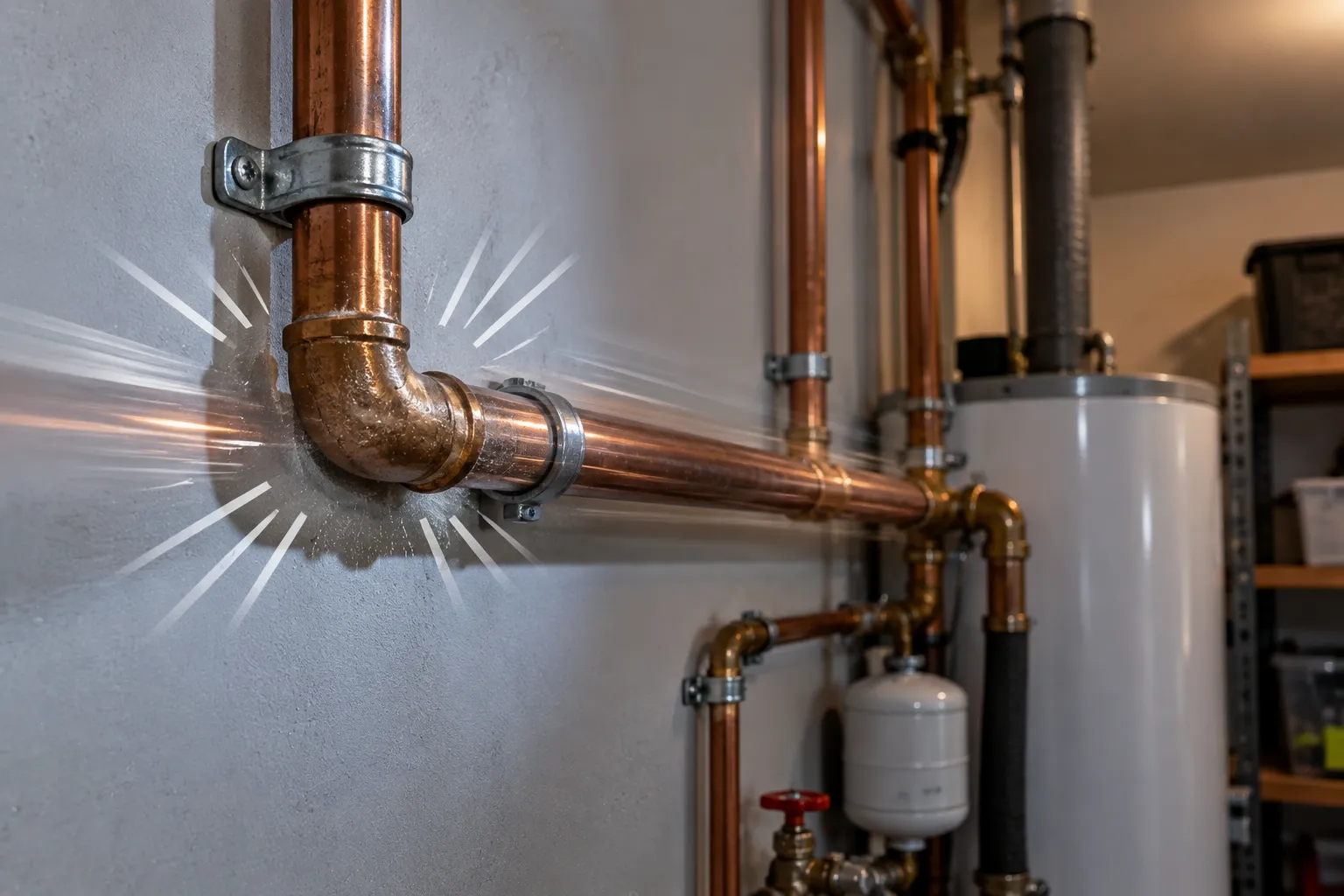
When copper is joined directly to older galvanised steel with no dielectric break between them, the two metals form a galvanic cell. That cell accelerates corrosion at the junction, narrowing the bore, discolouring the water and eventually producing pinhole leaks. Building inspectors report this defect most often on exactly the situation you would expect: partial re-pipes done over an older galvanised system.
So the obvious repair, cutting out the failed length and putting copper in, can create a new and faster failure right where the old and new metal meet. Done properly the junction gets a dielectric union, or the repair is made in the same metal. Done quickly and cheaply, it does not, and you are back in twelve months.
The Weakest Link Keeps Moving
There is a second reason patching disappoints, and it has nothing to do with metals. Pinhole leaks in a wall or under a floor also tend to go unnoticed for a long time, which is covered in our guide to hidden water leaks and the signs to look for.
Every length of galvanised pipe in the house is the same age and has carried the same water. When one section fails, the rest are not far behind. Replacing the failed section with new pipe gives you one strong link in a chain of weak ones, and the next failure simply happens at whatever is now the weakest point.
That is why people describe this as chasing leaks around the house. Each individual repair is sensible and each one is cheaper than a re-pipe. Added up over three or four years they often cost more, with the disruption spread across four separate visits instead of one planned job.
When to Replace Rather Than Patch
Patching is the right answer more often than a plumber keen to sell a re-pipe will tell you. Here is where each one genuinely fits.
One leak, no other symptoms
Clear water on the morning test, flow still acceptable throughout the house, and the failure is in a spot you can reach.
Ask for the junction to be made with a dielectric union or in matching metal.
You are selling within a year or two
Make the repair properly, keep the compliance paperwork, and disclose what you know. A re-pipe rarely returns its cost at sale, and a buyer’s drain and pipe inspection will find the pipe regardless.
Second or third leak in the same system
The pattern has told you what it is going to do. Further patches buy months.
Discoloured water that is not improving
Rust carrying through two or three mornings running means the internal surface is well gone. Replacement is the only complete fix.
Flow problems you have already chased
New tapware and a pressure test that reads normal, and it still will not run two outlets. The bore is the problem.
The walls are already open
During a bathroom or kitchen renovation the access is free. This is the cheapest re-pipe you will ever be offered, and our bathroom plumber page covers how that gets staged.
What a Replacement Involves
What It Gets Replaced With
Copper and polyethylene are both standard replacements and both are what water authorities point homeowners towards. Copper is rigid, long established and easy to run in exposed locations. Polyethylene and cross-linked polyethylene are flexible, which makes them far easier to thread through an existing wall or ceiling with less cutting.
The practical reason this matters is access. A flexible pipe can often be pulled through a cavity where a rigid one would mean opening the wall, and on a finished house the plastering and painting is a real share of the total cost.
Access and Disruption
This is what actually determines the size of the job. A single-storey weatherboard with a generous subfloor is close to the best case, because most of the run is reachable from underneath. A double-storey brick house on a concrete slab is close to the worst, because the pipework is in walls and between floors.
Expect water off for part of each day while the work is live, and expect some plaster to come out and go back. A good quote says where it will open up and who makes good afterwards, because that detail is where surprise costs hide.
Staging the Work
A whole-house re-pipe does not have to happen in one hit. Where the galvanised mains are near end of life but nothing has failed yet, a staged plan is reasonable: the worst run first, then the rest as budget or renovation work allows.
If you do stage it, the dissimilar metals issue above becomes a design decision rather than an accident. Every junction between the new and the remaining old pipe needs to be made properly, and your plumber should be able to tell you exactly where those junctions will be before any work starts.
What Drives the Cost
Two houses of the same size can differ enormously, and the pipe itself is a small part of it.
- Access above all else. Subfloor and roof space you can move through versus slab and double-storey walls. This factor outweighs every other one.
- How many outlets. A two-bathroom house with a laundry, kitchen and garden taps is considerably more pipe than a one-bathroom cottage.
- Making good. Plaster, tiles, paint and sometimes cabinetry. On a finished house this can rival the plumbing itself.
- Whether it is staged. Staging spreads the cost but adds visits, and each visit carries its own setup.
- What else gets done while the walls are open. Often the sensible moment to deal with an ageing hot water system or add an isolation valve that should have been there all along.
- Compliance paperwork. Plumbing work of $750 or more comes with a compliance certificate, which your plumber issues. Make sure it is in the quote conversation rather than an afterthought.
Get more than one quote, and compare what each one includes rather than the headline number. A cheaper quote that excludes making good and leaves the junctions to chance is not the cheaper job.
Talk to a Licensed Plumber in Melbourne
If the morning container test keeps coming back rusty, or you have had more than one leak in the same system, the useful next step is cutting out a short section and looking at the inside of the pipe. That tells you how much life is left and whether a repair is worth doing. Plumb Construct is licensed, works across Melbourne, and will tell you if patching is the sensible call rather than quoting a re-pipe by default.
📞 0424 932 737
📧 [email protected]
📍 Melbourne, VIC
📩 Request a Quote: Contact Page
Related Plumbing Services
Frequently Asked Questions About Galvanised Pipe Replacement
How do I know if I have galvanised pipes?
Three checks. If the plumbing has not been upgraded in roughly 40 years, galvanised is likely. Look for grey threaded steel pipe around 25 mm across where pipework is visible, under the house, in the laundry or at the hot water system. Then fill a white container from a tap first thing in the morning before anyone showers. Rust particles or discolouration two or three mornings running points to corroding galvanised pipe.
Is rusty water from galvanised pipes dangerous?
Water authorities describe the oxidised iron that galvanised pipes produce as generally not harmful to health. It is a performance and aesthetic problem rather than a safety one, though it does stain basins, toilets and laundry, blocks filters and shower roses, and signals that the inside of the pipe is deteriorating. If you have specific concerns about your water quality, your water retailer can advise on testing.
Can I just replace the section that is leaking?
Sometimes, and it needs doing carefully. Joining copper directly to older galvanised steel with no dielectric break creates a galvanic cell that accelerates corrosion at the junction, narrows the bore and eventually causes pinhole leaks. Building inspectors find this defect most often on partial re-pipes over older galvanised systems. If you patch, insist the junction is made with a dielectric union or in matching metal.
Why is my water pressure fine but the flow still bad?
Because they are different things. Corrosion builds scale inside the pipe and narrows the bore, which restricts the volume of water that can pass through while barely affecting the pressure a gauge reads at the meter. That is why a pressure test comes back normal and why new tapware, a new shower head or a pressure pump do not fix it. None of them widen the pipe.
Should I replace galvanised pipes before selling the house?
Usually not purely for the sale, since a re-pipe rarely returns its cost in the price. What does matter is repairing any active leak properly, keeping the compliance certificate, and disclosing what you know. Buyers who commission a plumbing inspection will find galvanised pipe anyway, so a documented repair reads far better than a problem that looks hidden.
Explore More
- All Posts
- Business & Specialty
- Costs & Guides
- Emergencies
- Fixes & Repairs
- public