Gutters Overflowing or Ceiling Wet After Melbourne Rain? How to Find the Cause
Table of Contents
- What to Do Right Now If Water Is Coming In
- Is It the Roof, the Gutters, or Something Inside?
- Why Melbourne Gutters Overflow in Heavy Rain
- Blocked Downpipes and What They Do to a Gutter
- How Often Should Gutters Be Cleaned in Melbourne?
- Box Gutters in Apartments: Why They Leak Inside the Building
- Where Roof Leaks Actually Start
- Why the Stain Is Never Directly Under the Leak
- Roof Plumber or Roofer? Who Fixes What in Victoria
- Why Some Melbourne Homes Leak Sooner Than Others
- Melbourne’s Rainfall Pattern and When Leaks Appear
- What a Plumber Checks During a Roof and Gutter Inspection
- Roof Leaks, Storm Damage and Home Insurance
- Frequently Asked Questions
Melbourne rain has a way of finding the weak point in a building. A gutter that coped all winter starts spilling over the edge in a spring downpour. A ceiling that has been dry for years develops a stain overnight. Both problems usually announce themselves during a storm and then disappear until the next one, which makes them easy to put off and expensive to ignore.
The first job is working out what is actually happening, because a wet ceiling is not always a roof problem. This guide covers how to tell the difference between a roof leak, an overflowing gutter and a leak coming from inside the building, what to do while water is still coming in, and who is licensed to fix each one in Victoria.
What to Do Right Now If Water Is Coming In
If water is entering the building as you read this, deal with the damage first and the diagnosis afterwards.
- Move furniture, electronics and stored items out of the affected area.
- Put a bucket under the drip and a towel under the bucket to stop splash spreading.
- If the ceiling is bulging or sagging, keep everyone out of the room. A ceiling holding pooled water can come down without warning.
- Turn off power to the affected area at the switchboard if water is anywhere near light fittings or power points.
- Photograph everything before you clean up. Insurers generally want images of the damage as it occurred.
- Do not climb onto the roof or a ladder in wet weather to investigate.
Once the immediate risk is handled, the questions below will narrow down what failed. For water that is pouring rather than dripping, our emergency plumbing guide covers what to do before help arrives.
Is It the Roof, the Gutters, or Something Inside?
A stain on the ceiling gets blamed on the roof by default, and it is often something else. The timing of the stain tells you more than its location does.
If the Stain Only Appears When It Rains
Water entering only during rain points to the building envelope: the roof covering, the flashing around a penetration, or a gutter overflowing back under the eaves. The heavier the rain needs to be before the stain appears, the more likely it is a gutter capacity problem rather than a hole in the roof. A genuine roof leak usually shows up in moderate rain too.
If the Stain Is There Regardless of Weather
A stain that stays wet during a dry week is not coming from outside. Common causes are a leaking pipe in the ceiling cavity, a failed hot water unit installed in the roof space, or a slow leak from a bathroom above. These need leak detection rather than roof work, and the warning signs are covered in our guide to hidden water leaks.
If It Gets Worse After Someone Showers
A stain that darkens within an hour of the shower being used is almost certainly coming from the bathroom above, not the roof. Failed waterproofing under the shower floor lets water through into the ceiling below, and it presents exactly like a roof leak to anyone standing underneath. Our guide on leaking showers explains how to confirm it.
| What you notice | Most likely cause | Who handles it |
|---|---|---|
| Only leaks in heavy rain, water runs down an internal wall | Gutter overflowing back under the eaves | Roof plumber |
| Leaks in moderate rain, stain directly below a roof penetration | Failed flashing around a vent, skylight or chimney | Roof plumber |
| Stain present in dry weather, no link to rain | Pipe leak in the ceiling cavity or hot water unit | General plumber |
| Stain darkens shortly after the shower is used | Failed shower waterproofing on the floor above | General plumber |
| Broken or slipped tiles visible from the ground | Damaged roof covering | Roofer |
| Water appears inside during storms in an apartment building | Box gutter overflowing internally | Roof plumber |
Why Melbourne Gutters Overflow in Heavy Rain
Gutters do not fail gradually. They cope until the volume of water exceeds what they can carry, and then they spill all at once. That is why the same gutter can handle months of winter drizzle and then overflow during a single spring storm.
Melbourne’s rainfall totals are spread fairly evenly through the year, but the intensity is not. Isolated storms can drop between forty and seventy millimetres in a day, particularly in the hills and outer suburbs. Rain also falls unevenly across the city, with areas near the Dandenong Ranges receiving well over double the totals recorded in the western suburbs. A gutter sized for average conditions has no margin left when one of those storms arrives.
Overflow matters because of where the water goes. Water spilling over the front edge lands in the garden and does little harm. Water backing up over the rear edge runs behind the fascia, into the eaves, and down inside the wall cavity. That is the version that produces a ceiling stain and gets mistaken for a roof leak.
Blocked Downpipes and What They Do to a Gutter
A clean gutter with a blocked downpipe still overflows. The downpipe is the only exit, and once it is restricted the gutter fills regardless of how clear the channel looks from the ground.
Blockages usually form at the outlet where the gutter meets the downpipe, where leaves and seed pods collect around the opening. They also form underground, where the downpipe connects to the stormwater line. An underground blockage is harder to spot because the visible parts of the system look fine while water backs up from below.
The quickest test is to watch the downpipe during rain. Water should discharge steadily at the bottom. If the gutter above is spilling while the downpipe runs slowly or not at all, the blockage is in the downpipe or the line it feeds, not in the gutter.
How Often Should Gutters Be Cleaned in Melbourne?
Twice a year suits most Melbourne properties: once in late autumn after the leaf drop, and once in early spring before the storm season. Properties with heavy tree cover often need more, and gutter cleaning is far cheaper than the repairs that follow an overflow into a wall cavity.
The right interval depends on what is above the roof and what the roof is made of.
Homes Under Established Trees
Eucalypts drop bark and leaf litter year round rather than in a single season, so a home under gums needs clearing more often than the twice-yearly baseline. Deciduous street trees such as plane and elm concentrate their drop into autumn, which makes the timing predictable but the volume heavy. Suburbs with established canopy see this most, including the areas covered by our Malvern plumbers and Elsternwick plumbers.
Homes with Metal or Colorbond Roofs
Metal roofs shed debris more readily than tiled roofs, so less material reaches the gutter. The trade-off is corrosion. Wet debris sitting against a metal gutter holds moisture against the surface and starts rust at the base of the channel, which is where most metal gutters fail first. In coastal areas salt accelerates it further, something our Brighton plumbers see regularly.
When Gutter Guard Helps and When It Does Not
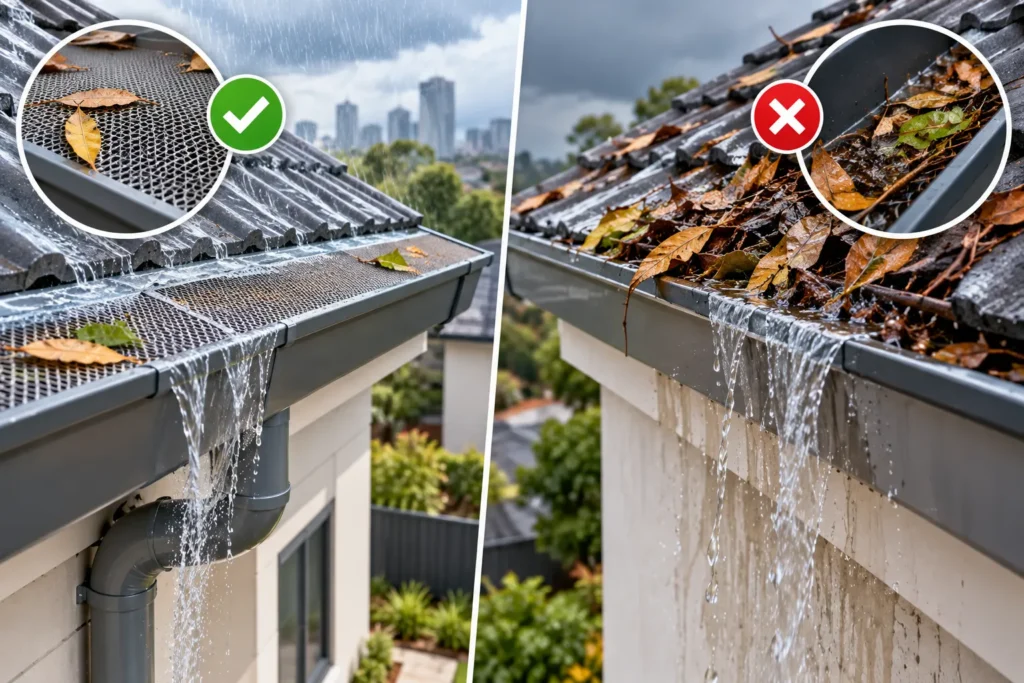
Gutter guard reduces how much reaches the gutter, and it works well against large leaves. Fine material such as eucalypt bark strands, seed pods and roof grit still passes through or builds up on top of the mesh, and a guard covered in compacted debris sheds water over the edge rather than into the gutter. Guard reduces cleaning frequency. It does not remove the need for it, and any installer who says otherwise is selling rather than advising.
Box Gutters in Apartments: Why They Leak Inside the Building
A box gutter runs between two roof sections or behind a parapet wall rather than along the outside edge of the roof. They are common in apartment buildings, converted warehouses and terraces with parapet frontages.
The difference matters enormously. When a conventional gutter overflows, the water spills outside the building. When a box gutter overflows, there is no outside edge for it to spill over, so the water goes into the roof structure and down through the ceiling. A box gutter failure presents as a serious internal leak with no visible sign of a problem from the street.
Box gutters are fitted with overflow provisions for exactly this reason, and those provisions are the first thing to check when an apartment develops an unexplained ceiling leak during storms. In strata buildings the box gutter is normally common property, which makes it an Owners Corporation matter rather than an individual owner’s. Buildings with these configurations are common in the areas covered by our Collingwood plumbers and South Yarra plumbers, and recurring issues across multiple units are usually better handled through scheduled strata plumbing than repeated callouts.
Where Roof Leaks Actually Start
When the problem genuinely is the roof, it is rarely a hole in the middle of it. Roofs fail at their joins and edges.
Flashing and Valleys
Flashing seals the join where the roof meets something else: a wall, a chimney, a vent pipe, a skylight. Valleys carry water where two roof planes meet. Both handle concentrated water flow and both rely on a seal that degrades over time. Together they account for a large share of roof leaks.
Ridge Capping and Mortar
On tiled roofs the ridge capping is bedded in mortar along the peak. Mortar cracks and loosens with decades of thermal movement, and once it does, wind-driven rain enters at the highest point of the roof and can travel a long way before it appears.
Cracked or Slipped Tiles
A single cracked tile is enough. Tiles crack from foot traffic during antenna or solar installation, from falling branches, and from hail. Slipped tiles leave a gap that only leaks when rain arrives at a particular angle, which is why some roofs leak in one storm and not the next.
Rust and Failed Seals on Metal Roofs
Metal roofs fail at fixings and laps rather than across the sheet. The rubber washers under roofing screws perish and allow water past, and rust starts where two sheets overlap and hold moisture. Both are repairable long before the sheet itself needs replacing.
Why the Stain Is Never Directly Under the Leak
Water that enters at the ridge does not fall straight down. It runs along the underside of the roof covering, drops onto the sarking, follows the sarking to a low point, then runs along a rafter or a ceiling joist until it finds a join in the plasterboard. By the time it appears in the room below it can be several metres from where it entered.
This is why guessing is expensive. Cutting into a ceiling directly above a stain frequently reveals nothing, because the entry point is somewhere else entirely. Tracing the water path back through the roof space, ideally during or immediately after rain, is what locates the source without unnecessary damage.
Roof Plumber or Roofer? Who Fixes What in Victoria
These are separate licensed trades in Victoria, registered separately with the Victorian Building Authority, and each is restricted from performing the other’s work. Knowing which one you need saves a wasted callout.
What a Roof Plumber Covers
Roof plumbing covers the water management side: gutters, downpipes, box gutters, rain heads, flashings and the connection into the stormwater system. Anything to do with getting water off the roof and away from the building sits here.
What a Roofer Covers
Roofing covers the roof surface itself: tiles, ridge capping, metal sheeting, roof structure and full replacement. Broken tiles and damaged ridge caps are roofing work.
When You Need Both
Storm damage frequently affects both the covering and the drainage, which means both trades. A reasonable contractor will tell you when the job falls outside their registration rather than attempting it. If you are unsure who to call first, our guide on finding a reliable plumber in Melbourne covers what to check before booking anyone.
Why Some Melbourne Homes Leak Sooner Than Others
Building age and type change both the likelihood of a leak and its usual cause.
Period and Pre-1960s Homes
Older homes often have original ridge mortar, undersized gutters designed before modern rainfall expectations, and roof spaces with no sarking beneath the tiles. Without sarking there is no second line of defence, so a single displaced tile becomes an immediate internal leak. Established suburbs with period housing see this pattern consistently, including areas served by our Malvern and Elsternwick teams.
Apartments and Converted Buildings
Parapet walls, internal box gutters and shared roof structures mean leaks are more likely to appear inside and more complicated to attribute. Responsibility usually sits with the Owners Corporation where the roof and box gutters are common property, though the exact split depends on the building’s Plan of Subdivision. Our Collingwood and South Yarra teams work across these buildings regularly.
Newer Estates and Recent Builds
Recent homes leak for different reasons: flashing installed incorrectly, downpipes not connected properly to the stormwater line, or gutters set at a fall that does not drain. These are workmanship issues rather than wear, and they often surface within the first few years while builder’s warranty still applies. Worth checking your warranty position before paying for a repair. Our Tarneit plumbers see this across newer estates.
Melbourne's Rainfall Pattern and When Leaks Appear
Melbourne’s reputation for unpredictable weather is well earned, and it shapes when roof and gutter problems show up. Rainfall is spread relatively evenly across the year rather than concentrated in a wet season, with October typically the wettest month.
Melbourne’s rainfall is spread relatively evenly across the year rather than concentrated into a wet season, and October is typically the wettest month. But the totals are not what causes a gutter to fail. Intensity is.
| Rainfall pattern | What the gutter does | What you notice |
|---|---|---|
| Steady winter drizzle over several hours | Water arrives slower than the downpipe removes it, so the gutter never fills | Nothing. A partly blocked gutter copes with this indefinitely |
| Moderate rain over an hour | The gutter runs close to capacity but still clears | Possibly a slow-running downpipe, easy to miss |
| Spring or summer storm, 40 to 70 mm in a day | Volume exceeds what the system can carry and the gutter spills all at once | Water over the edge, and often a ceiling stain a day later |
| Storm arriving on dry summer ground | Baked soil sheds water instead of absorbing it, so more reaches the drainage faster | Pooling in the yard as well as gutter overflow |
Rain also falls unevenly across the city. Areas near the Dandenong Ranges regularly record well over double the totals measured in the western suburbs, which is why a gutter arrangement that works on one side of Melbourne can be undersized on the other.
This is why leaks appear suddenly in spring and summer rather than during the wetter, gentler winter months, and why the right time to clear gutters is before storm season rather than after the first failure.
The totals only tell part of the story. Even monthly distribution means gutters rarely get a dry period long enough for anyone to notice a problem before the next rain arrives. More importantly, the damage comes from intensity rather than volume. A month of light drizzle causes no overflow at all, while a single spring thunderstorm delivering forty to seventy millimetres in an afternoon overwhelms the same system completely.
That is why leaks appear suddenly in spring and summer rather than during the wetter, gentler winter months. It also explains why the best time to clear gutters is before storm season rather than after the first failure.
What a Plumber Checks During a Roof and Gutter Inspection
A proper inspection covers more than the obvious. The checks below are what separate finding the cause from replacing the most visible component.
- Gutter fall and alignment, since a sagging section holds water permanently and rusts first.
- Downpipe flow during a hose test, including the underground connection.
- Flashing condition at every roof penetration.
- Valley condition and debris build-up where two roof planes meet.
- Ridge capping and mortar on tiled roofs.
- Box gutter overflow provisions where present.
- Roof space inspection for staining on rafters and sarking, which shows the water path.
- Fascia and eaves for signs of long-term overflow behind the gutter.
Where the source still is not clear, moisture meters and thermal imaging trace water through the structure without cutting anything open. The same equipment used for leak detection applies here.
Roof Leaks, Storm Damage and Home Insurance
Insurance treats sudden damage and gradual deterioration very differently, and roof leaks can fall either side of that line.
Storm damage is generally covered: a tree branch through the roof, tiles lifted by wind, or hail damage. Gradual failure usually is not. Rusted gutters, perished flashing and cracked mortar are typically treated as maintenance rather than an insurable event, and a claim can be declined on the basis that the failure developed over time.
Blocked gutters are the difficult middle ground. Where an insurer determines that overflow occurred because gutters had not been maintained, the resulting water damage may not be covered. Keeping receipts for gutter cleaning is worth more than it sounds when a claim is being assessed.
Photograph damage before any cleanup or temporary repair, and check your product disclosure statement rather than assuming. Speak to your insurer before committing to works if a claim is likely.
Talk to a Licensed Plumber in Melbourne
If your gutters are overflowing or a ceiling is staining after rain and you need to know what has actually failed before booking a repair, Plumb Construct’s licensed Melbourne plumbers can inspect the roof drainage, trace the water path and tell you exactly what the property needs.
Call 0424 932 737
Email [email protected]
300 Plummer St, Port Melbourne VIC 3207
Related Plumbing Services
- Roof & Gutter Repairs – gutters, downpipes, flashing and storm damage.
- Professional Leak Detection – tracing leaks with no visible source.
- Burst Pipe Repairs – for pipe failures inside the ceiling cavity.
Related reading: why showers leak into the room below, hidden water leak warning signs, and what to do before the plumber arrives.
FAQs - Gutters Overflowing or Ceiling Wet After Melbourne Rain?
Why is my ceiling wet when it rains?
Rain-only leaks point to the building envelope: the roof covering, flashing around a penetration, or a gutter overflowing back under the eaves. If the stain is also present in dry weather, the cause is usually internal, such as a pipe leak in the ceiling cavity or a leaking shower on the floor above.
Can a blocked gutter cause a ceiling leak?
Yes, and it is more common than people expect. When a gutter overflows backwards rather than over the front edge, water runs behind the fascia into the eaves and down inside the wall cavity, producing a ceiling stain that looks exactly like a roof leak.
How often should gutters be cleaned in Melbourne?
Twice a year suits most properties: once after the autumn leaf drop and once before storm season in early spring. Homes under eucalypts or heavy street tree canopy usually need it more often, since those trees shed year round rather than in a single season.
Do I need a roof plumber or a roofer?
Roof plumbers handle water management: gutters, downpipes, box gutters, rain heads and flashings. Roofers handle the roof surface: tiles, ridge capping, sheeting and replacement. They are separately registered trades in Victoria and each is restricted from performing the other’s work. Storm damage often needs both.
Why is the stain not directly under the leak?
Water entering the roof runs along the underside of the covering, onto the sarking, and then along rafters or ceiling joists before dropping through a join in the plasterboard. It can appear several metres from the entry point, which is why cutting into the ceiling above a stain often reveals nothing.
Is a roof leak covered by home insurance?
Sudden storm damage is generally covered, while gradual deterioration such as rusted gutters or perished flashing usually is not. Where an insurer finds that overflow occurred because gutters were not maintained, the resulting damage may be declined. Check your product disclosure statement and speak to your insurer before committing to works.
Why does my roof only leak in very heavy rain?
That pattern usually indicates a capacity problem rather than a hole. Gutters and downpipes cope until the volume exceeds what they can carry, then overflow all at once. A genuine roof leak generally shows up in moderate rain as well.
What is a box gutter and why does it matter?
A box gutter runs between roof sections or behind a parapet wall rather than along the outside edge. When it overflows there is no outside edge for water to spill over, so it discharges into the building. That is why box gutter failures in apartments present as serious internal leaks with nothing visible from the street.
Does gutter guard mean I never have to clean my gutters?
No. Gutter guard reduces how much debris reaches the gutter and works well against large leaves, but fine material such as bark strands, seed pods and roof grit still gets through or builds up on top of the mesh. It reduces cleaning frequency rather than removing the need for it.
Can I check my own gutters?
Visual checks from the ground during rain are safe and useful: watch whether the gutter spills and whether the downpipe discharges steadily. Do not climb onto a roof or use a ladder in wet weather. Most serious injuries in this area come from ladder falls rather than from the plumbing problem itself.
Can a roof leak cause mould?
Yes. Water held in insulation, plasterboard or timber creates conditions for mould, and it can develop before any stain is visible. A musty smell in a room with no obvious damp patch is worth investigating rather than ignoring.
How quickly should a roof leak be repaired?
The roof itself does not deteriorate quickly, but the structure below it does. Water reaching ceiling insulation, plasterboard and framing turns a contained repair into a much larger one, and the cost gap between fixing it early and fixing it late is usually far greater than the original repair.
Explore More
- All Posts
- Business & Specialty
- Costs & Guides
- Emergencies
- Fixes & Repairs
- public