Tree Roots in Sewer Pipes: Who Pays in Melbourne?
Tree roots in sewer pipes are one of the most common causes of a blocked drain in older Melbourne suburbs. Who pays to fix them depends on which section of pipe the roots are in. Whose tree they came from matters much less, which surprises a lot of people with a big council gum out the front.
Every Melbourne home’s sewer is split at a connection point, usually near the front boundary. The pipes on your side of that point belong to you, and you pay to clear or repair them. The pipe from the connection point to the sewer main belongs to your water retailer, and they fix it at their cost. A camera inspection shows which side the roots are on.
Where Your Pipe Ends and the Water Retailer’s Begins
The three water retailers that cover our service area each describe the boundary a little differently. Your water bill shows which one you are with.
| Water retailer | Where its responsibility starts |
|---|---|
| Yarra Valley Water | At the inspection opening (IO), or up to 1 metre from the property boundary, whichever is less |
| South East Water | At the connection point with your property, often near the boundary, which South East Water calls the inspection opening |
| Greater Western Water | At a fitting called the 27A. The pipe from the 27A to the sewer main is Greater Western Water’s |
Sources: Yarra Valley Water, South East Water and Greater Western Water.
In older homes the inspection opening is often buried under a garden bed, lawn or paving laid decades after the house was built. Yarra Valley Water notes that if a boundary trap is buried, its crews can’t clear a blockage until the point is raised to ground level, and arranging that is the owner’s job.
Who Pays for Tree Roots in Sewer Pipes
Roots in Your Section of Pipe
You pay, even when the roots come from a council street tree or your neighbour’s tree. Water retailers don’t cover private pipes. Yarra Valley Water states that it is not responsible for internal pipes and will not reimburse internal pipe repairs.
Roots in the Retailer’s Section
The retailer fixes it. If a plumber finds the blockage is past the connection point, stop and call the retailer’s faults line before any more work is done. Greater Western Water tells plumbers not to work on a blockage in its section and to call its Faults and Emergencies team on 13 44 99. It also says the customer may be eligible for reimbursement of the plumber’s fee. Yarra Valley Water’s faults line is 13 2762.
If sewage spills onto your property because of a failure in Yarra Valley Water’s system, its customer charter says it will pay all costs resulting from the spill.
Roots From a Council Street Tree
Councils generally leave pipe repairs to the owner. Merri-bek City Council, which covers Coburg, says in its tree roots handout that it is the landowner’s responsibility to maintain, repair or replace their stormwater and sewer pipes, and that council will not remove a tree because its roots are in private pipes.
The same handout says tree roots are extremely unlikely to damage intact pipes. Roots get in through cracks, faulty joints and poorly installed pipes, and that is the argument a council will make if you ask it to pay.
Council can still help. Merri-bek asks residents to contact its Urban Forest team before digging near a street tree so an arborist can inspect and prune the roots. Boroondara, which covers Kew and Camberwell, offers arborist inspections when council tree roots damage private property. If you believe a council was negligent, you can lodge a claim, but you will need evidence: CCTV footage, photos and a plumber’s written report.
Roots From a Neighbour’s Tree
This is a matter between you and your neighbour. The water retailer and council won’t step in. Get the camera footage first, then talk to your neighbour. If the damage is serious and they won’t contribute, get legal advice before spending money on a claim.
Why Roots Get Into Sewer Pipes in a Dry Spring
Roots grow towards water. A cracked sewer joint leaks moisture into the soil around it, and in a dry season that pipe is often the wettest thing in the garden. The Bureau of Meteorology’s outlook for October to December 2026 points to below-average rainfall and unusually warm days and nights across south-eastern Australia, so tree roots in sewer pipes are likely to cause more blockages through late spring and summer.
Older homes carry the most risk. Many period houses still have earthenware (clay) sewer pipes laid in short lengths, and every joint is a place a fine root can get in. Add mature street trees and established gardens, and blockages tend to keep coming back. This is common in older streets in Kew, Camberwell, Malvern, Toorak, Brighton and Coburg.
Newer homes in estates such as Tarneit and Point Cook have PVC sewer pipes with glued joints, and root intrusion there is much less common. When it does happen, it is usually where the pipe was damaged during landscaping.
How a Plumber Works Out Whose Pipe It Is
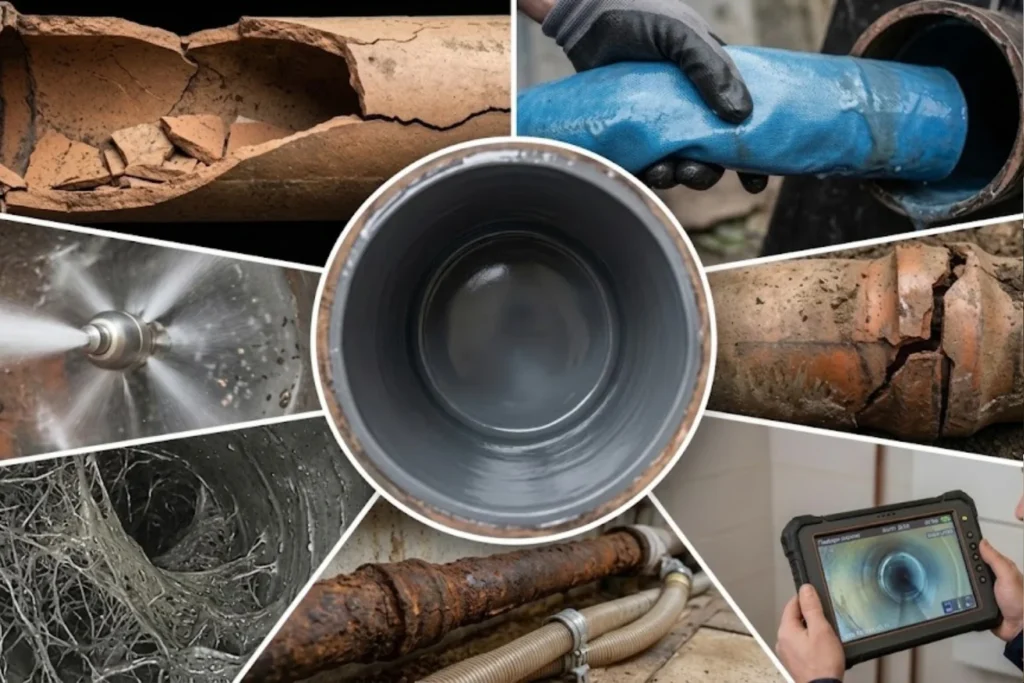
Before anyone argues about who pays, you need to know exactly where the roots are. This is how a plumber checks:
- A CCTV camera goes into the sewer through an inspection opening or the overflow relief gully and the footage is recorded.
- The camera cable is marked in metres, and the problem spot can be marked on the surface above the pipe.
- That spot is measured against the inspection opening, the 27A or the property boundary to show whose section it is in.
- You get the footage and a written report you can send to the water retailer, the council, your neighbour or your insurer.
Our guide on how blocked drains are repaired explains the camera, root cutting and jetting in more detail.
What Affects the Cost of Tree Root Repairs
Every root job is different, so the price depends on what the camera finds. Plumb Construct provides a fixed upfront quote before any work begins. These are the things that change the cost:
- How deep the pipe is and how easy it is to reach.
- How much of the line is cracked or full of roots.
- Whether the damaged section can be relined or has to be dug up and replaced.
- Whether the inspection opening has to be found or raised to ground level first.
Root cutting and drain cleaning clear the pipe, but the crack is still there and the roots grow back through it. Pipe relining puts a new pipe inside the old one and seals the joints. In most gardens it means no digging under the driveway or around the tree.
When to Call a Plumber
Call a plumber if you notice any of these:
- More than one fixture drains slowly or gurgles, such as the toilet and shower at the same time.
- Water or sewage comes up through the overflow relief gully outside.
- The same drain blocks again within months of being cleared.
- Patches of lawn over the sewer line stay green and soggy while the rest of the garden dries out.
Sewage coming out of the gully or into the house needs a plumber the same day, and our blocked drains plumbers in Melbourne can run the camera on the same visit. For more warning signs, see our guide to the causes and signs of blocked drains. If water is pooling in the yard after rain rather than backing up from the sewer, it is a stormwater problem with different rules, explained in our stormwater responsibility guide.
Related Plumbing Services
If you’re dealing with a plumbing emergency right now, don’t wait call Plumb Construct’s emergency plumber Melbourne team immediately.
📞 0424 932 737
📧 [email protected]
📍 Melbourne, VIC Request a Quote: Contact Page
Frequently Asked Questions About Tree Roots in Sewer Pipes
Does council pay if a street tree’s roots block my sewer?
Usually not. Councils treat the pipes on your property as yours to maintain, and Merri-bek says so directly in its tree roots guidance. You can ask council for an arborist inspection, and if you believe council was negligent you can lodge a claim with CCTV footage, photos and a plumber’s report.
Is my water retailer responsible for tree roots in sewer pipes?
Only if the roots are in its section, between the connection point and the sewer main. Roots anywhere on your side of that point are yours to fix.
Where is the sewer connection point on my property?
It is usually near the front boundary, marked by an inspection opening with a screw cap or, with Greater Western Water, a fitting called the 27A. In older homes it is often buried. A plumber can find it with a camera and locator.
Will cutting the roots out fix the problem?
It clears the blockage for now. The crack or joint the roots came through is still open, so they grow back. Relining or replacing the damaged section is the lasting fix.
How do I prove whose pipe the roots are in?
Ask for the CCTV footage and a written report showing where the roots are, measured from the inspection opening or the property boundary. That is what a water retailer, council or neighbour will ask to see.
Explore More
- All Posts
- Business & Specialty
- Costs & Guides
- Emergencies
- Fixes & Repairs
- public